The company that runs itself
I watch a lot of YouTube and forget most of it. So I am starting a series here. When a video teaches me something I want to keep, I write it down. This is the first one.
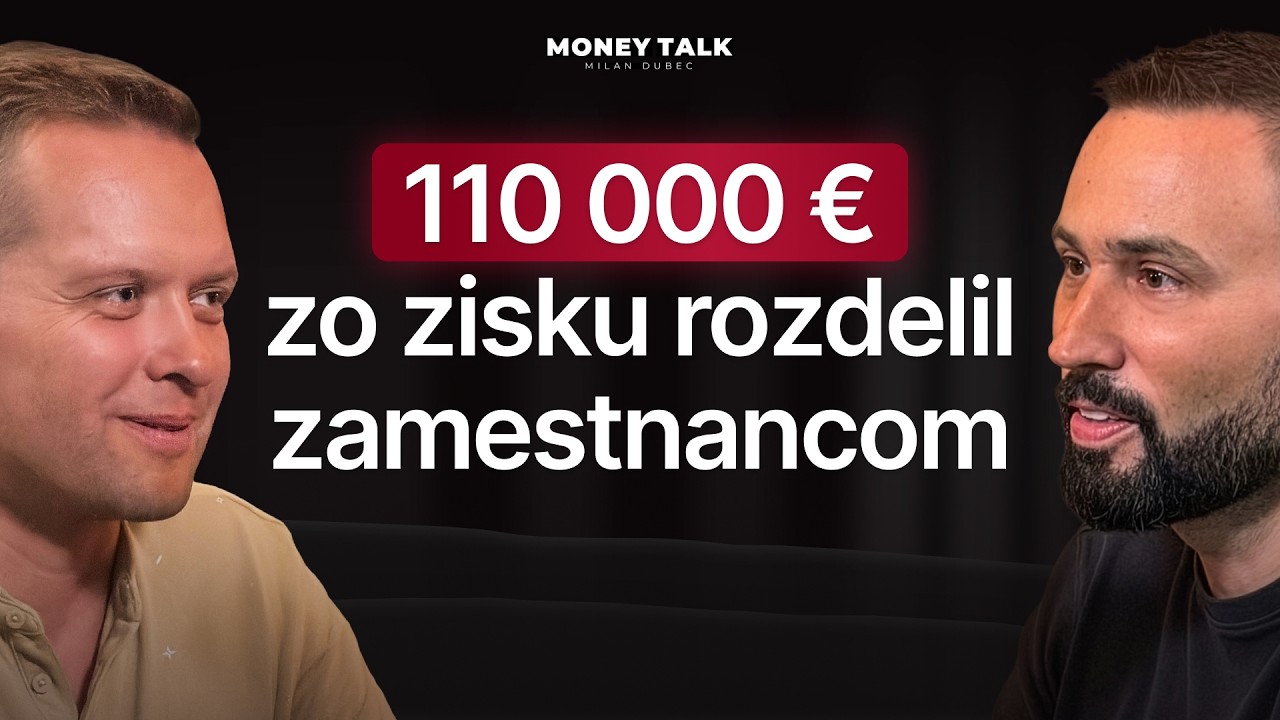
The video is an episode of Money Talk, a Slovak podcast hosted by Milan Dubec. His guest is František Baník, who goes by Fero, co-owner of a heating installation company called Baník a syn in Vranov nad Topľou, eastern Slovakia. The thumbnail sells the hook: he paid out 110,000 euros of profit to his employees last year. That turns out to be the least interesting thing in the conversation.
It runs about ninety minutes in Slovak. Auto-translated captions carry it fine.
Fero has a PhD in mechatronics. Fifteen years ago he built a working self-navigating vehicle, then walked away from it. He had read Jim Collins on the hedgehog concept and asked himself what people would still pay for in a hundred years. His answer was hot water. He has since asked 3,900 people at conferences whether they shower. About 98 percent do, at least weekly. So he sells the machines that heat the water. When Dubec points out he could have been a billionaire in autonomous vehicles, Fero shrugs and says they are both sitting there happy, so no mistake was made.
The company he took over from his father had eight people, 187,000 euros of revenue and a 30,000 euro annual loss covered with family money. His father had built it out of a privatised textile plant's boiler room in the nineties, servicing loans at 16 to 23 percent interest by producing steam cheaper than the regulated price he was allowed to sell it at. When the textile factories died, the firm nearly went with them.
What Fero built instead came from an odd place. He ran a student radio station for six years and watched volunteers get up at four in the morning to haul speaker cabinets for no money at all. That convinced him people run on more than salary. His stated goal for the company is that every colleague in work overalls behaves the way he would behave standing there in the overalls himself.
Today it is 62 people, 5.13 million in revenue, an NPS of 79, and a plan measured in centuries. Here is what I took from it.
1. Open books are a retention strategy
Fero's best people could leave tomorrow and clone the business. Heating installation has no moat. Instead of guarding the numbers he shows them everything: marketing costs, tooling, overheads, margins per job. Anyone with a spreadsheet can work out that leaving means more hours for less money once you add up what the company quietly absorbs on your behalf. The arithmetic does the retaining. One of his competitors keeps the numbers hidden and has watched his own firm splinter four times.
2. Truth told repeatedly becomes trust
The first time Fero showed a crew that a job had lost money, they did not argue. They simply did not believe him. They had sweated on that roof all day, so obviously the job earned. He kept showing real numbers after every single project, for years, and belief arrived on its own schedule. Only then did installers start volunteering things like: next time price in a lift platform for 150 euros, it saves us a day. The suggestion engine every founder wants switches on only after the trust is built, and trust gets built by boring repetition of true things.
3. Pay people by their distance from profit
He has a written document he calls the compensation constitution. It sorts every role by how much influence it has on a job's profit. Direct influence, meaning the sales rep who priced the job and chose the discounts, earns 20 percent of that job's profit. Semi-direct, meaning the installers who decide between bending a pipe themselves and fitting seven-euro elbows, share 35 percent. Indirect, meaning the cleaner, the warehouse keeper and the CFO alike, share 5 percent across all jobs in the company. Sixty percent of every job's profit has to leave the company this way.
In that last pool the cleaner receives the same share as the CFO. Dubec asks whether that is right. Fero says it is, and that the CFO's difference belongs in base salary, not in the profit split. It is the cleanest frame for profit sharing across roles I have come across.
4. Trust given at 100 percent comes back at 100 percent
This is the part people will quote at him forever. Every Sunday at six each person gets a report listing the jobs they worked that week and rates their own performance. If they judge it exceptional they type in a bonus for themselves. Any amount. Nobody approves it. It pays out automatically. The only condition is that the table of who took what runs on the TV dashboards around the company all of the following week.
Dubec pushes him. What if someone writes in 20,000 euros? He pays it. He gave his word that nobody would approve these, and there is nobody above them to approve anything anyway. What if six people do it at once? Then the company goes bankrupt, and, as Fero puts it, people will keep showering. Peer accountability in groups of about eight does the policing, and someone gaming it gets what he calls spat out by their own crew.
A cap would turn 100 percent trust into 99 percent trust, which is a different thing. I do not know that I would have the nerve. I do know that every approval step I have ever added to a company was a small message that I did not trust the people I hired.
5. Belief scales further than comprehension
Almost nobody in the company can follow the full mechanics of the employee share vehicle and the per-share payouts. Fero does not need them to. Asked whether the cleaning lady understands the system, he says she does not have to understand it, she has to believe it. Founders over-invest in making everyone understand every mechanism. What compounds is a track record of the mechanism paying out exactly as promised.
6. Give every unit its own P&L, then get out of the way
Each branch carries its own budget, evaluates itself, and shares only in its own result. The Bratislava branch lost money in its first year, so Bratislava got nothing, and nobody in the east felt robbed. Decisions sit where the knowledge sits. His line for this stuck with me: you cannot know, from a tall building in Bratislava, what the woman behind the counter in Medzilaborce needs. When the service technicians want a new field on their service form, they message the developer directly and he adds it. Fero does not know what is on his own boiler service form any more, and he counts that as the system working.
7. Turn perks into budgets
Nobody there is entitled to a car of a certain class. Each person carries their real monthly cost to the company and chooses how to spend it. A 5-series BMW and a smaller salary, or a Škoda and the difference in cash, or a bicycle and all of it. One of his sales reps drives cheap and wants the newest iPhone. Another does the exact opposite. Even Fero's own pay and car come out of the time the branches buy from him, which means the branches effectively decide what he drives.
The tedious argument about who deserves which perk disappears and becomes a trade-off each person prices for themselves. Dubec stopped the interview at this point to say he was taking the idea back to his own company. I understand the impulse. I have had the same conversation about car categories more than once and never liked my own answer.
8. Put the refund in the front line's pocket
An NPS of 79 in home services is absurd. It comes from what happens in the first minutes after a customer turns sour. The technician standing in the yard, or the agent on the phone, can grant a discount or a free service next year on the spot. There is no escalation. For customers who insist on speaking to the boss, the operator says they will go and consult Mr Baník, waits five minutes, and comes back with the discount. The crews play along because the dashboards show them what a referral lead is worth against paid marketing. Front-line authority holds when the front line can see why it pays.
9. Teach the economics, then let them feel the loss
At an all-hands, Fero sat his people in fours and had them design their own heating company. Day rate, headcount, how many installers per sales rep, marketing spend, working days in a month. Only the table of sales reps produced a viable business. The installers priced themselves at 150 euros a day and each ended up about 10,000 euros a month in the red, before anyone mentioned lawyers or the transaction tax. Their conclusion was that putting a business together borders on the superhuman.
A related fact almost nobody on a payroll ever hears: your salary is roughly half of what you cost your employer. If you want people to think like owners, hand them the model and let it collapse in their hands. No lecture I could give would land as fast.
10. Pick a hundred-year problem and think in centuries
He left autonomous vehicles because he could not see himself in them for a century. Hot water passed the test. He values the company at a modest 250,000 euros, keeps 95 percent in the family, and turns down outside capital because on a 250-year horizon it makes no difference whether the Žilina branch opens in 2027 or 2038. You can quarrel with the valuation. The calm it produces is real. No forced exit, no growth theatre, no panic.
Somewhere in there is a quiet argument against most of the startup culture I grew up in, and I have not finished thinking about it.
Watch it here: Money Talk with Milan Dubec and František Baník. I made a full English translation of the transcript while watching. If you want it, write to me.